
Feeling Old in Experience Space
Photograph: Usamah Khan / Unsplash (CC0).
Edited with AI.
Lately I have been trying to make sense of a strange feeling: I feel old. This is not a claim about my age, and it is not tiredness or disenchantment. It is closer to the impression that I have already sampled many of the basic ways in which life can feel.
One way to describe this is to imagine experience as a multidimensional space. Each axis represents a type of experience. There might be an axis for eating something extraordinary, another for drinking too much, another for traveling somewhere unfamiliar, and others for intimacy, friendship, solitude, joy, grief, fear, and so on.
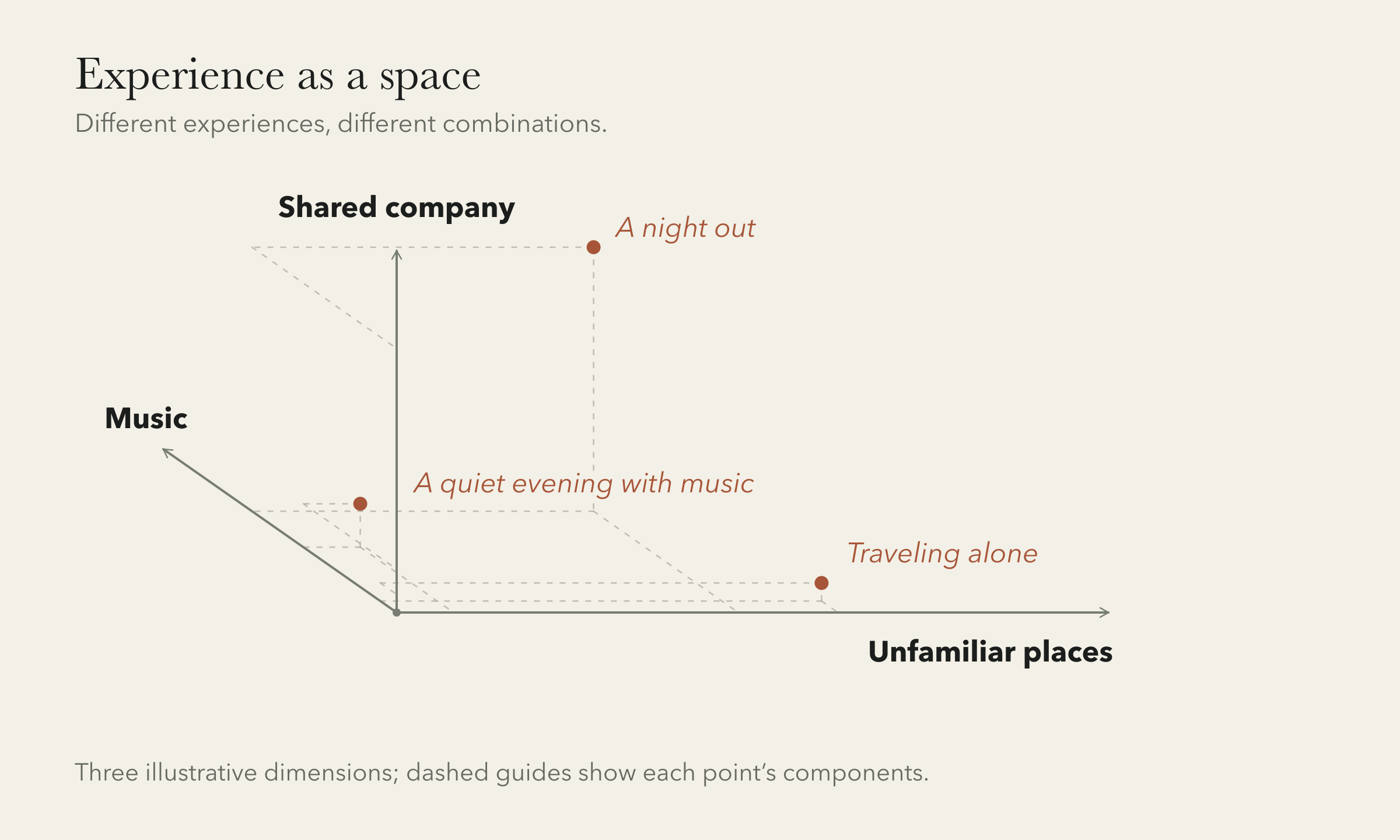
This is not meant as a rigorous coordinate system. There is no unique choice of axes, and not every feature of experience will behave linearly. Still, the picture is useful. Any particular experience can be treated as a point in that space, with coordinates along several axes. A night in Lisbon, a breakup, or a quiet afternoon with wine and music each combines familiar elements in a different way.
We do not need to visit every point in order to develop a sense of the space. Once we have moved along enough directions, we can begin to interpolate.
Suppose someone tells me about an extraordinary night at a jazz bar in Tokyo. I have never had that particular experience. But if I have spent time in unfamiliar cities, felt slightly out of place and still curious, listened to music I did not understand, and shared drinks with strangers, then the story is not completely alien. I cannot know exactly what that night felt like, but I can imagine some of its contours from experiences I already have.
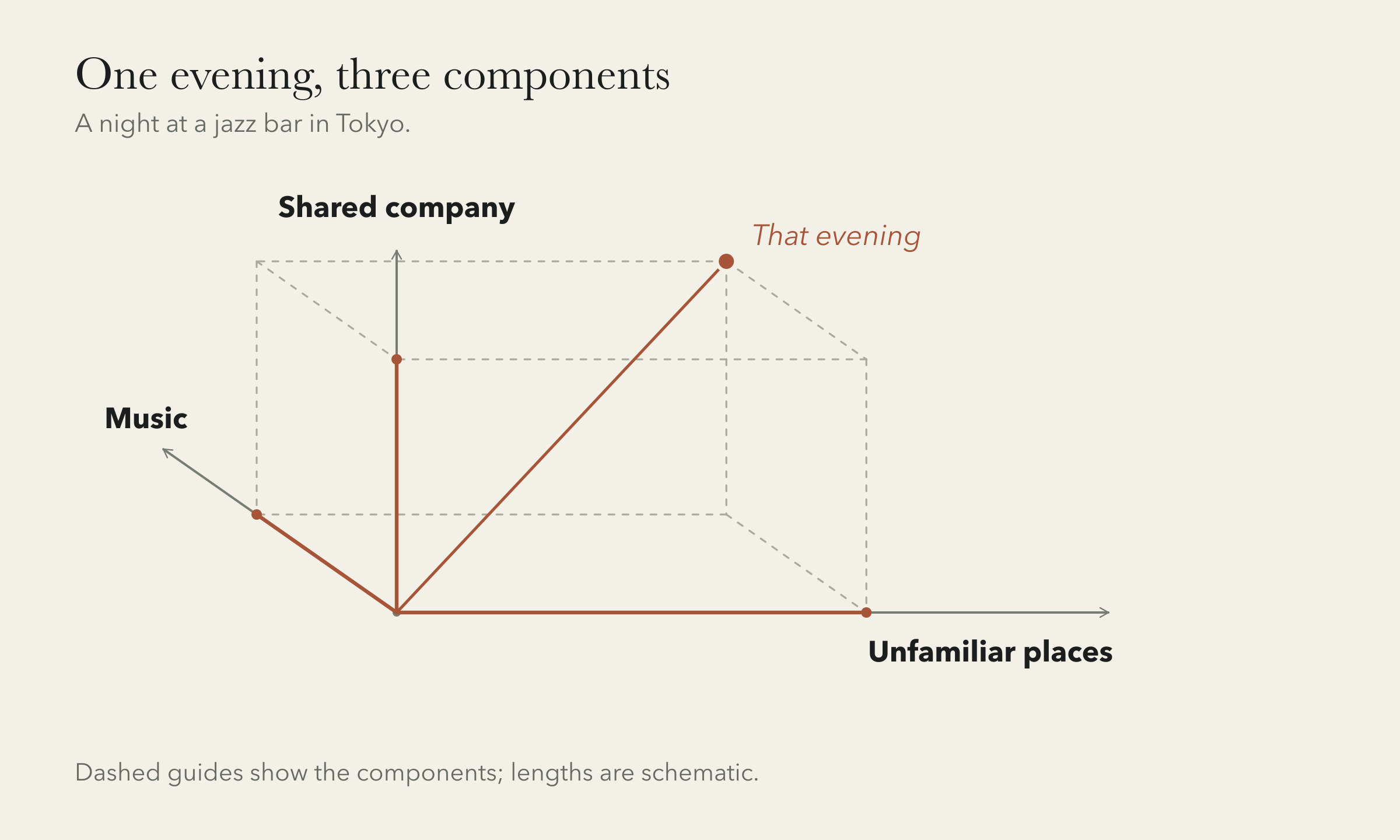
This is what I mean when I say that I feel old. I do not think I have done everything. That would be obviously false. The number of possible experiences is effectively endless. But there is a difference between visiting every point in a space and having covered enough directions to recognize much of its shape. New experiences can be genuinely new while still feeling imaginable.
There are at least two directions that I know I have barely moved along. The first, fortunately, is serious violence. I have never had to fight for my life, seriously hurt someone, or endure that kind of physical threat. I can imagine fear, pain, anger, and helplessness separately, but I do not know what their combination becomes under violence.
The second is parenthood. I have never raised a child. Conversations with friends who are parents can teach me a great deal, but I suspect that responsibility, attachment, exhaustion, and love are transformed when another person's life depends on you. I can name the ingredients, yet I do not know the experience they create.
Other directions once felt equally inaccessible. My first psychedelic experience gave me no familiar model to fall back on. It did not simply increase the intensity of something I already knew. It changed what seemed possible to experience. Something similar happened with meditation. The first real encounters with stillness were not merely calmer versions of ordinary consciousness. They introduced a different coordinate.
How many axes remain outside my current map? There may be forms of experience that I cannot anticipate precisely because I lack the concepts needed to represent them. Before the first genuinely unfamiliar experience, I may not even know which direction is missing.
A model built from past experience is good at describing combinations of what we already know. It is much worse at revealing dimensions that have never appeared in the data. Feeling able to imagine something is not the same as understanding it, and familiarity can become overconfidence.
I am not making a metaphysical claim that life can be reduced to a vector space. This is only a way of describing why novelty sometimes feels less mysterious with time. As our internal map becomes more detailed, many new situations fall inside regions we already recognize. We may pay less attention to the broad outlines and more to differences in texture, tone, and context.
So perhaps feeling old in this sense means having explored enough directions that much of experience has become recognizable. That familiarity should not be mistaken for completeness. A new experience can still surprise us by revealing an axis we did not know existed, and that possibility is a good reason to remain curious.
Discussion
Comments
Comments are moderated before appearing. Your email is used only for moderation or a reply and is never published.
Checking for recent comments…
No comments yet.