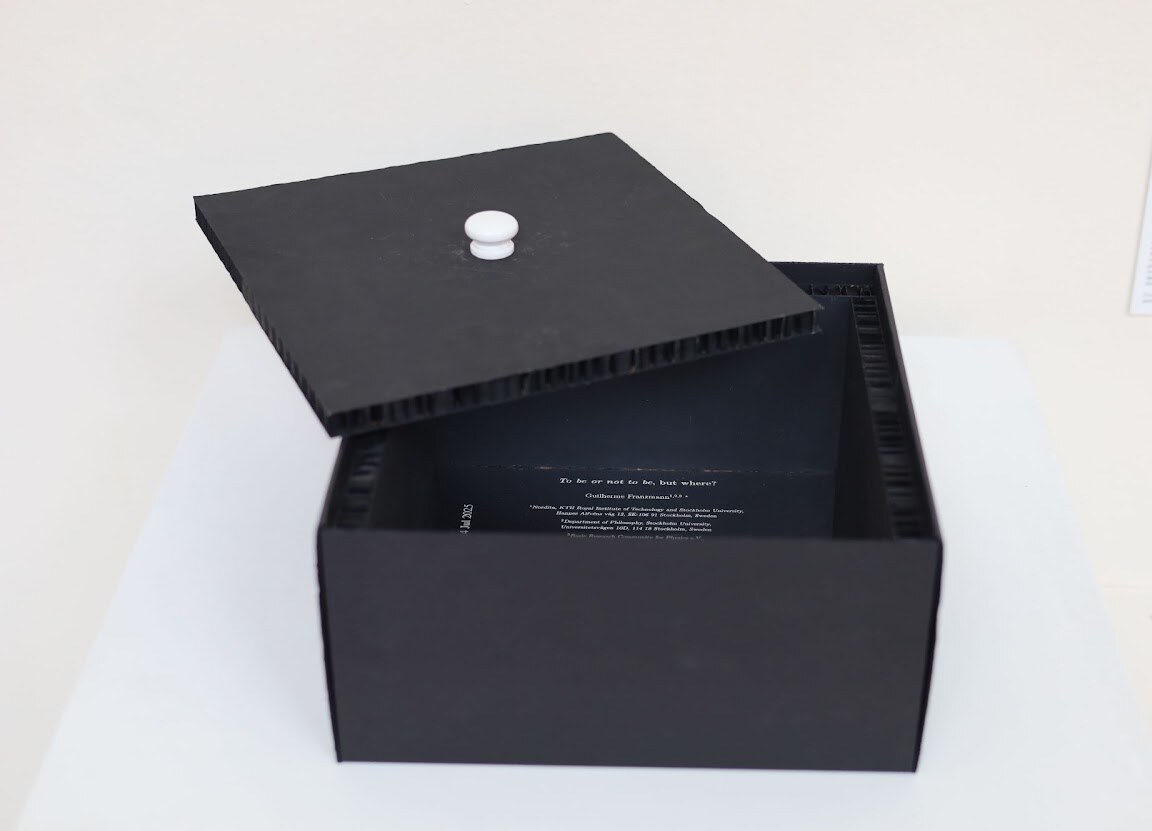
To Be or Not to Be, but Where?
On 30 April 2026, To Be or Not to Be, but Where? was presented at CreSci’s Between Art and Science exhibition at mudaC in Carrara. I was one of twelve international scientists invited to translate a piece of research into an exhibition work. The project asked us to move an idea out of the familiar language of papers and arguments and discover what it might become through an artistic collaboration.
The artwork and concept were developed by me and my artist collaborator, Jennifer Taufer, with Jennifer also contributing curatorially. The work re-presents the question explored in the paper To Be or Not to Be, but Where?: what does it mean to identify something as a physical system when its boundaries and location cannot simply be taken for granted?
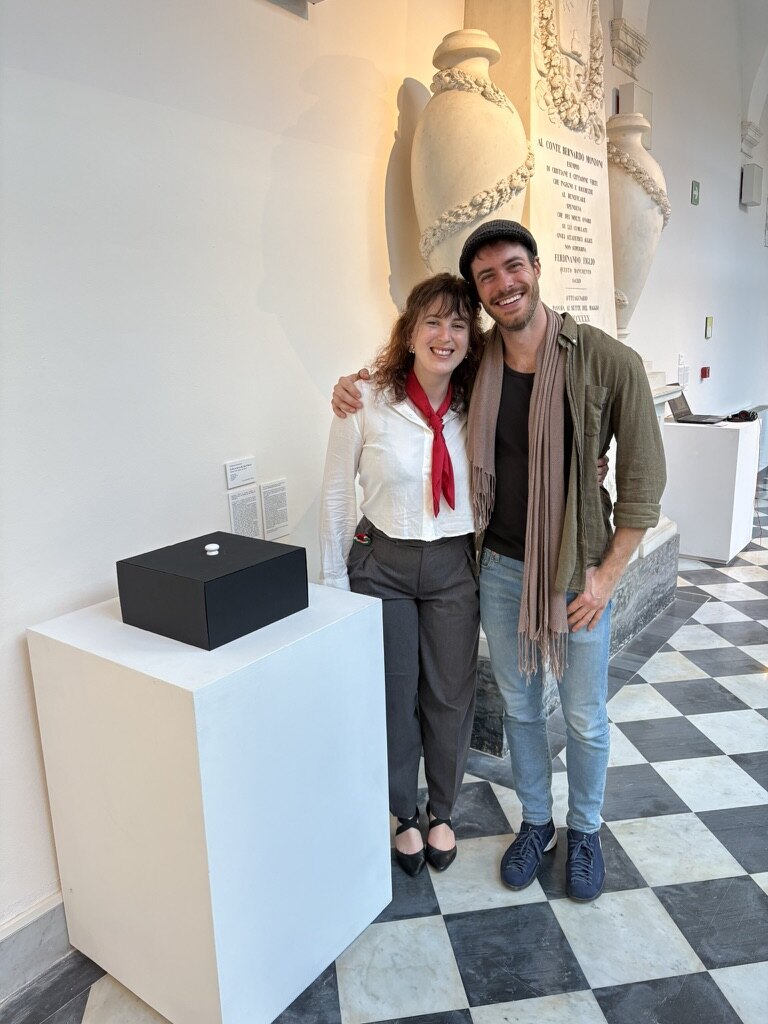
The work
This work turns a scientific paper into a simple physical encounter: a black box that must be opened. Inside, the viewer finds the printed article resting on a reflective surface. The gesture is ordinary, almost playful, but it stages the central problem of the research in material form.
The paper asks what it really means to say that something is a physical system. In everyday life, we assume that the world is naturally divided into separate things, each with its own place, as if these boundaries were simply there to be discovered. But modern physics makes this picture less secure. A system is not always something given once and for all from nowhere; it is often identified through relations: between observer and observed, between one part and another, between a way of describing the world and the world described. What counts as “inside” and “outside” is not always absolute.
The mirror makes this intuition immediate. To look inside the box is, inevitably, also to see oneself. The viewer does not simply observe an object from an external and impartial position, but becomes part of the very scene of observation. In trying to discover what is inside the box, one also discovers something about one’s own position in relation to what one is trying to know. The work thus suggests that there may be no fully objective gaze capable of finding the world already divided into its parts. To understand what is there also means questioning the point from which one looks.
What would you charge?
Until this point, I had approached the project as an academic. I receive a fixed salary: if a paper occupies a month of work, I am paid for that month regardless of whether the paper ever produces any income of its own. An artist who makes a living by selling work faces a very different equation. If an artwork occupies a month, its sale may be what pays for that month.
That is why putting a price on the box stopped feeling like a practical detail. It became another part of the exchange between science and art, and the part that taught me the most. Before reading on, try making your own estimate: what should the artwork cost, and how much do you think the box itself cost to produce? Keep the second number in mind. I will come back to it at the end.
My first thought was €200. I knew what I had paid to have the boxes made, and that concrete figure anchored my estimate. Knowing very little about art-market pricing, I described the project to ChatGPT and asked for a second opinion. It suggested a price in the range of €600–700. That already felt like a substantial correction.
Then I called Jennifer. She thought even that was too low. She made the contrast concrete: suppose this were not a salaried academic project, but the work from which I had to make a living. If it represented something like a month of labor, its price could not merely reimburse the materials; it would also have to cover a month of rent, food, and bills.
It is difficult to say exactly how much time is contained in a scientific paper, or in transforming one into an artwork. But Jennifer’s reasoning changed how I understood the question. I had been pricing an object; she was asking what price would allow the person who made it to keep working. After that conversation, we set the asking price at €2,000.
And the fabrication cost I asked you to estimate? We had two boxes made; including the fabrication service, they cost about €50 each. Now you know.
Discussion
Comments
Comments are moderated before appearing. Your email is used only for moderation or a reply and is never published.
Checking for recent comments…
No comments yet.