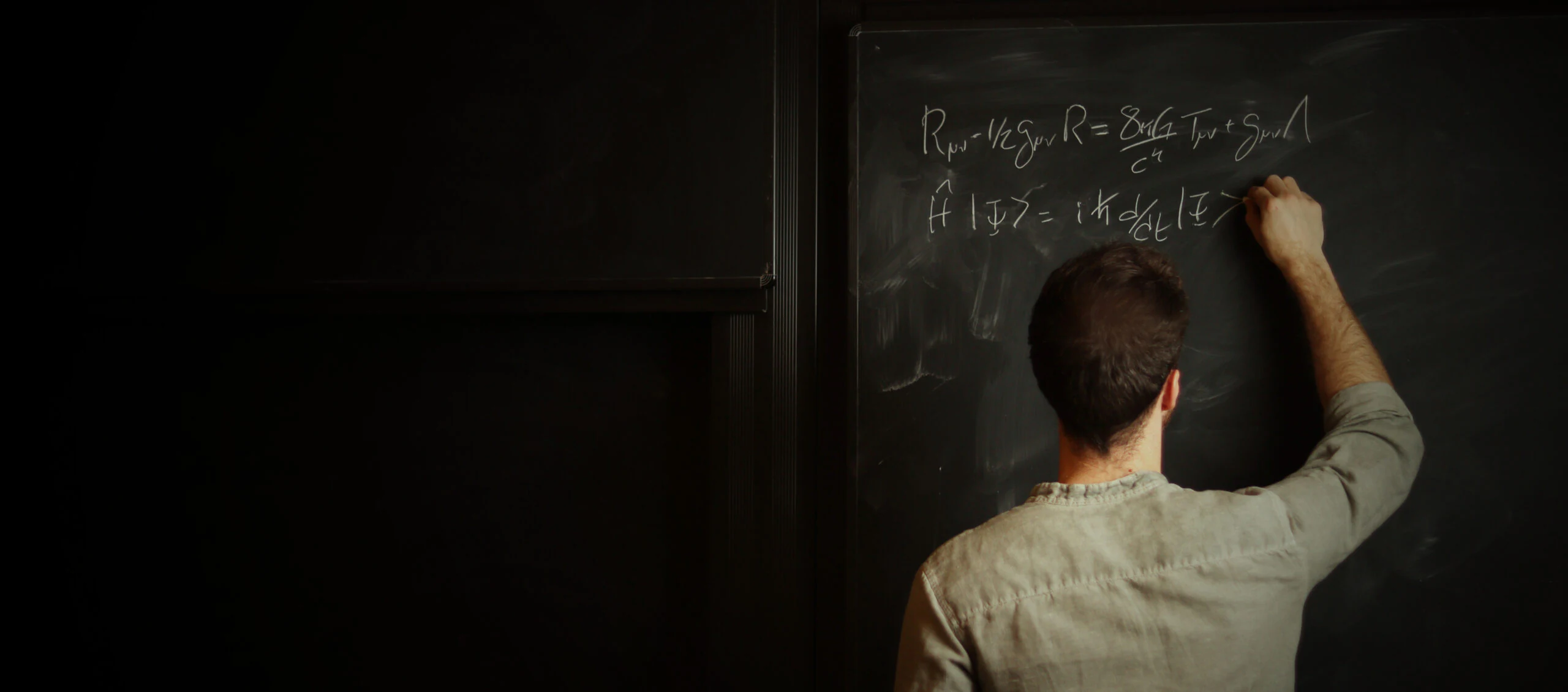
Philosophy of Physics
Eight lectures from classical mechanics and spacetime to quantum theory and emergence
Course archive · 2024–2025
Foundational physics through discussion
This course explored the meeting point between fundamental physics and philosophical inquiry through classical mechanics, spacetime and relativity, quantum mechanics, and emergence. It brought together students from physics, philosophy, and neighboring disciplines, prioritizing conceptual understanding over technical calculation.
Close reading and lively discussion were central: the aim was not to settle every question, but to identify hidden assumptions, compare interpretations, and ask better foundational questions.
Course information
The course was organized around eight discussion-led lectures. The sessions combined conceptual introductions, close discussion of arguments, group exercises, thought experiments, and qualitative engagement with equations. No prior university-level physics was assumed: mathematics was used as a language for understanding what a theory says, without requiring students to solve the equations themselves. The principal guides were David Wallace’s Philosophy of Physics: A Very Short Introduction and Sean Carroll’s The Biggest Ideas in the Universe: Space, Time and Motion and Quanta and Fields.
Course structure
The course relied on reading-led, in-class discussion. Students could submit short reading summaries and questions before each session, allowing the lectures to combine review, clarification, and discussion around the questions they found most interesting. The format was informal and interactive, and the lecture sequence moved from classical mechanics and the nature of spacetime to quantum theory, interpretation, and emergence.
Assessment design
The course used an individual, conversational oral assessment. Students discussed two questions drawn from different lecture topics, with emphasis on conceptual connections and the reasoning behind an answer rather than recall of isolated details. The assessment was designed as a continuation of the course’s discussion-based pedagogy.
Local archive
Lectures and slide decks
C’mon! It’s just first lecture, so let’s take it easy: Permanence and Impermanence
This opening lecture asks what physics is, where philosophy enters, and why foundational questions matter. It moves from the history of natural philosophy to Popper’s falsificationism, underdetermination, instrumentalism, and scientific realism, then uses Kuhn’s account of paradigms to show how observation and theory develop together. The final turn is toward classical mechanics: patterns, symmetries, conservation, and the conceptual shift from Aristotelian motion to Newton’s laws. Rather than treating philosophy as commentary added after physics, the lecture presents it as part of the work of clarifying what physical theories say about the world.
Open lecture slides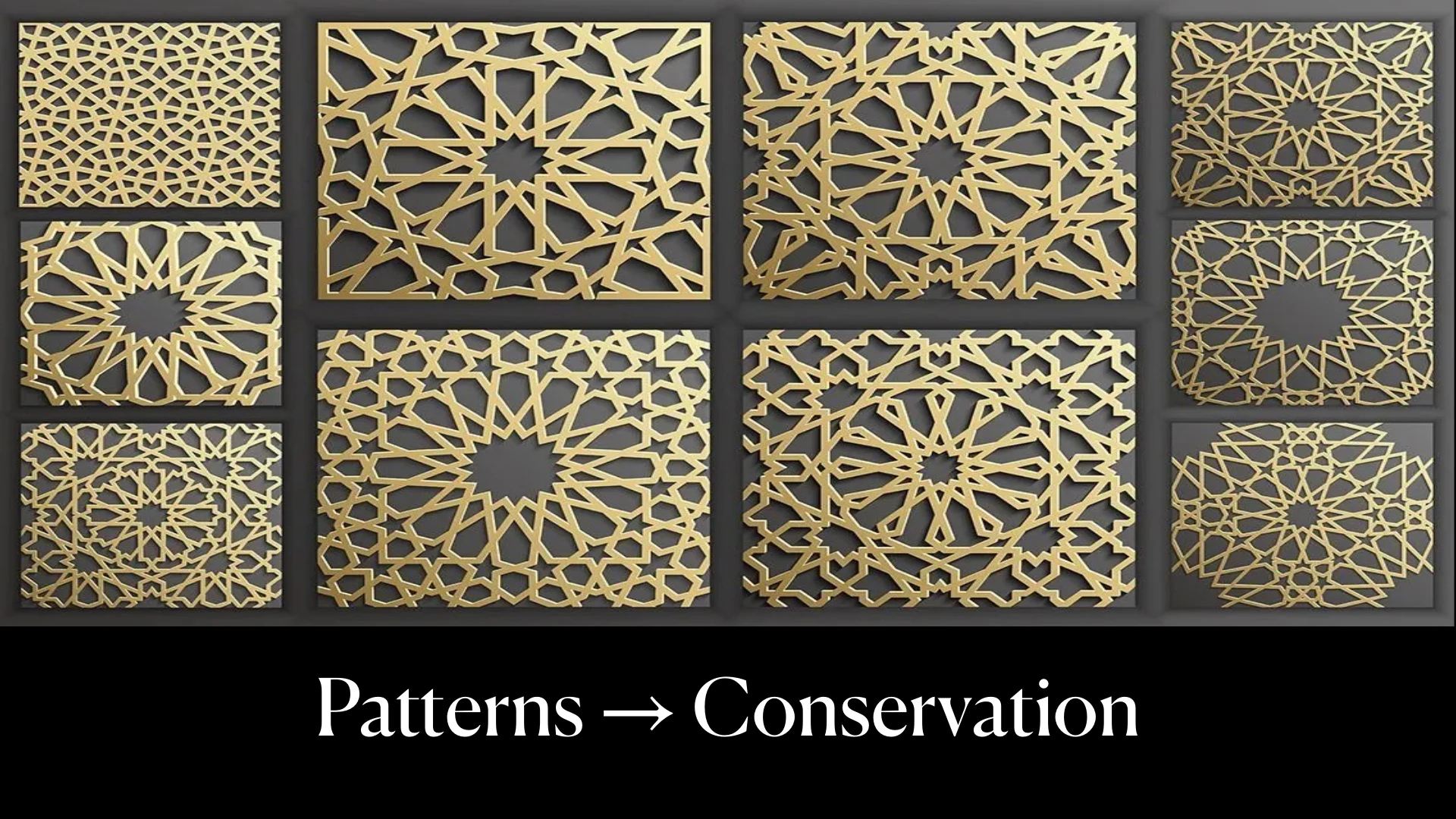 PDF · local
Motion, inertia, and let’s befriend Newton
This lecture asks what it means for something to move when absolute rest cannot be observed. It stages the debate between substantivalism and relationalism, develops Galilean relativity and inertial reference frames, and introduces spacetime as the structure that distinguishes inertial from accelerated motion. The geometry-first and dynamics-first views then sharpen the question of whether spacetime explains motion or merely summarizes the dynamics. Gravity complicates the picture further: its universality suggests that inertial structure may be local and dynamical rather than a fixed background.
Open lecture slides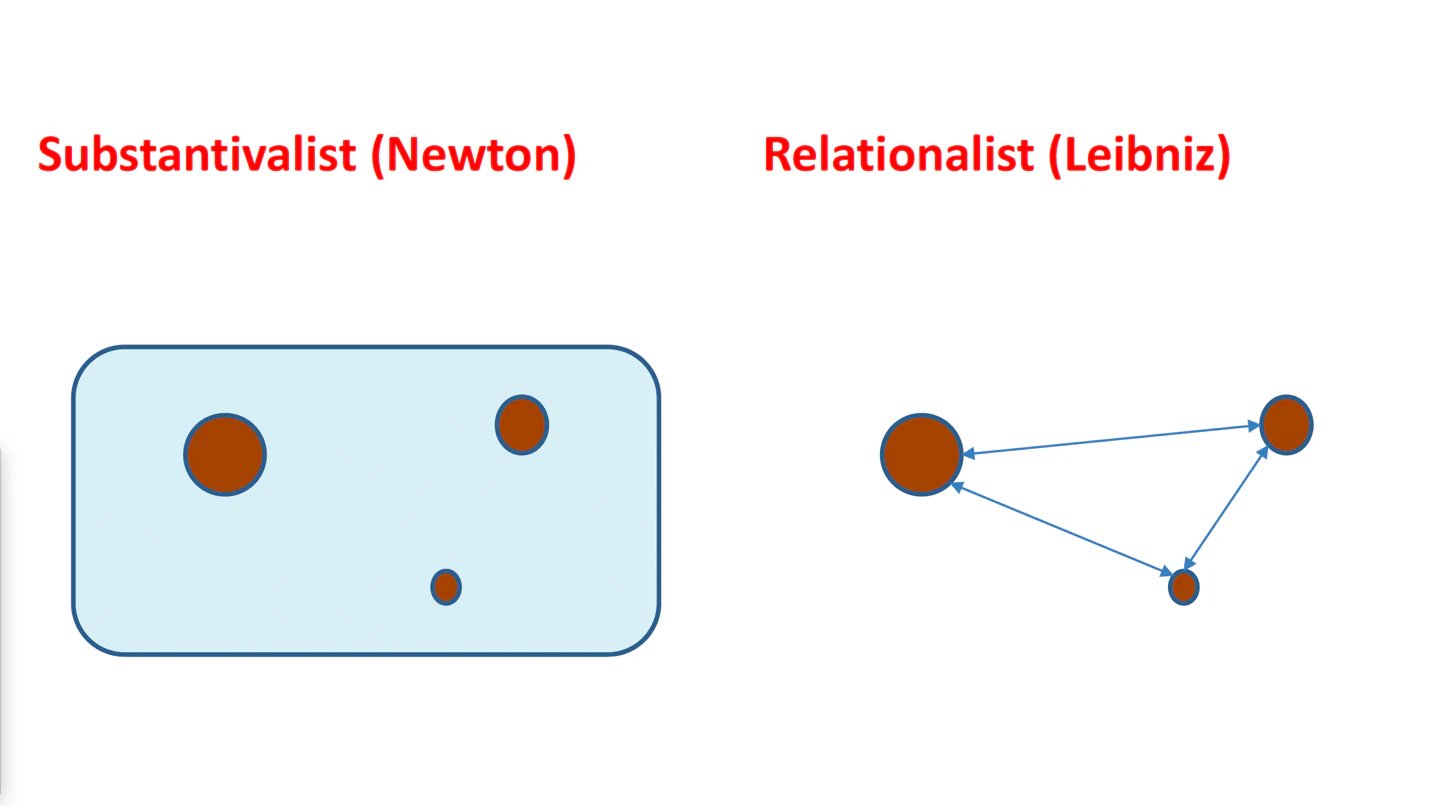 PDF · local
It’s about time! Entropy and the arrow of time
Time plays several roles: it labels moments, measures duration, and provides a direction for evolution. This lecture contrasts substantival and relational views of time, then confronts a central puzzle: fundamental dynamical laws are time-reversal symmetric, while ordinary experience is not. Entropy, microstates and macrostates, coarse-graining, and the low-entropy past supply the bridge from reversible laws to a thermodynamic arrow of time. The lecture closes by comparing presentism, the growing past, and eternalism, asking what a scientifically realist reading of physical theory should make of passage, memory, and the distinction between past and future.
Open lecture slides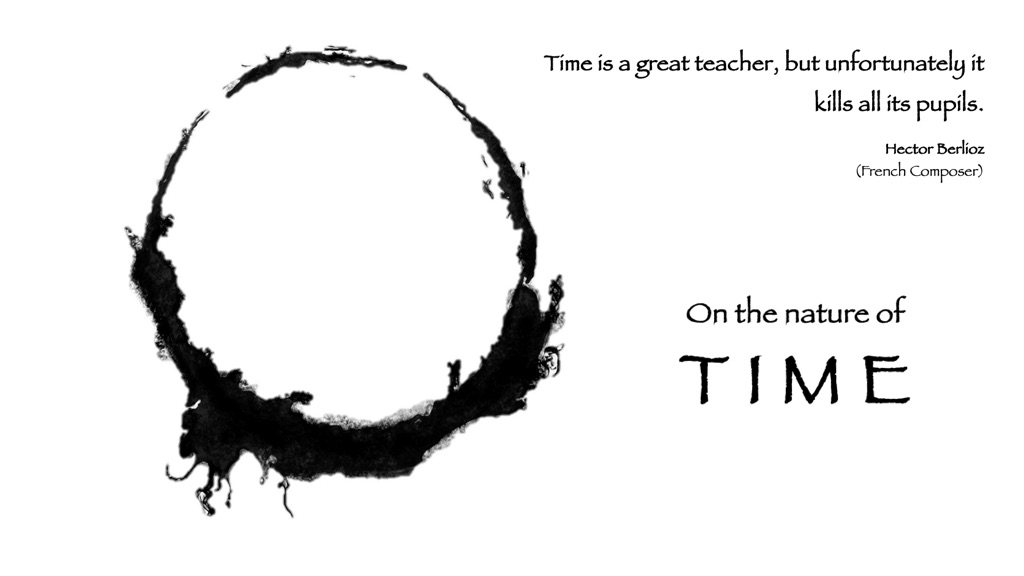 PDF · local
Einstein comes along, and now space and time are relative
This lecture follows the path from Newtonian and Galilean spacetime to Minkowski spacetime. Sound and light motivate the problem of waves and their media; the Michelson-Morley experiment and Einstein’s two postulates then recast the principle of relativity. From there, the lecture develops the relativity of simultaneity, light cones, invariant spacetime intervals, proper time, time dilation, length contraction, and the twin paradox. The philosophical question running through the session is what remains objective when measurements of space and time depend on an observer’s inertial frame.
Open lecture slides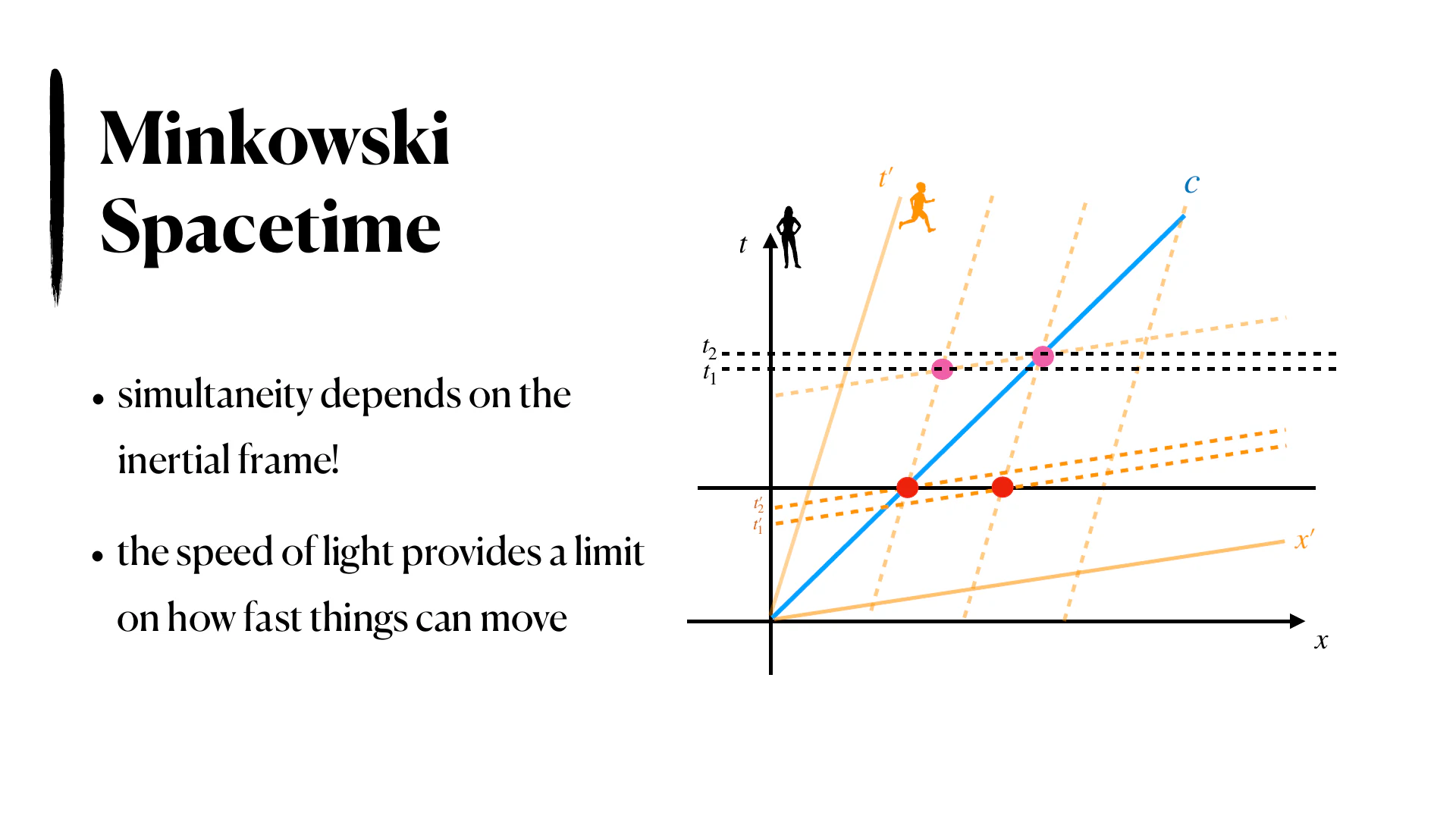 PDF · local
Guess what, Einstein says space and time are also dynamical!
The move to general relativity begins with non-Euclidean geometry, manifolds, and the possibility that physical geometry need not follow everyday intuition. The lecture then connects the equality of inertial and gravitational mass to the universality of free fall and Einstein’s principle of equivalence. Gravity is no longer simply a force acting within spacetime: matter and energy shape a local, dynamical inertial structure encoded by curvature. Einstein’s field equation opens the final part of the lecture, where the same framework is used to think about the large-scale history and expansion of the Universe.
Open lecture slides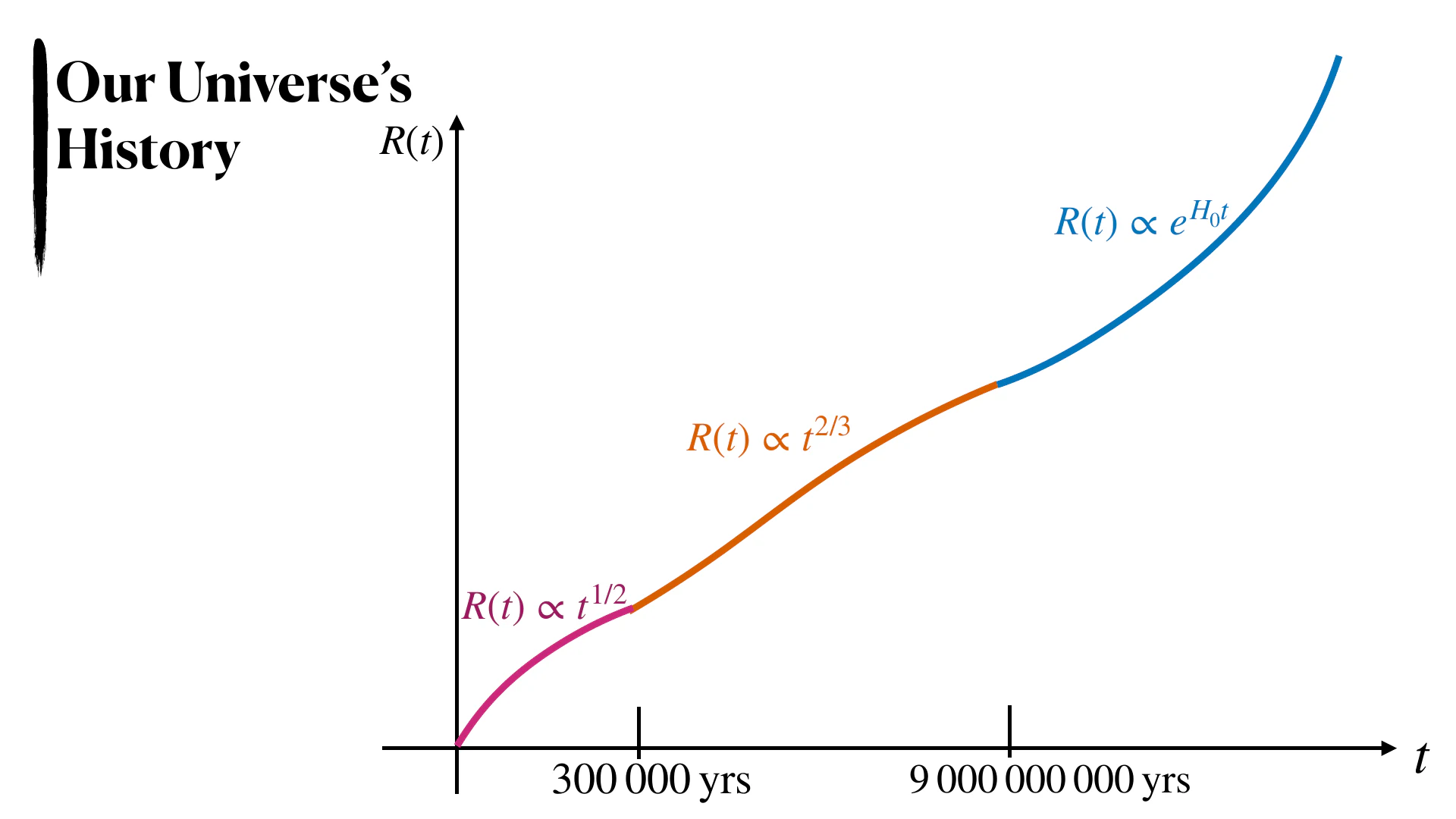 PDF · local
The microscopic world is nothing like ours!
The double-slit experiment provides the entrance to quantum mechanics. Light and electrons display interference, while individual detections remain localized; closing a slit or asking which path was taken changes what appears. The lecture connects this puzzle to atomic spectra, black-body radiation, and the photoelectric effect before introducing the wavefunction, the Schrödinger equation, and the Born rule. Measurement then brings a second kind of evolution into view: apparent collapse, irreversibility, uncertainty, and the unresolved question of whether the wavefunction represents physical reality or only probabilities for possible observations.
Open lecture slides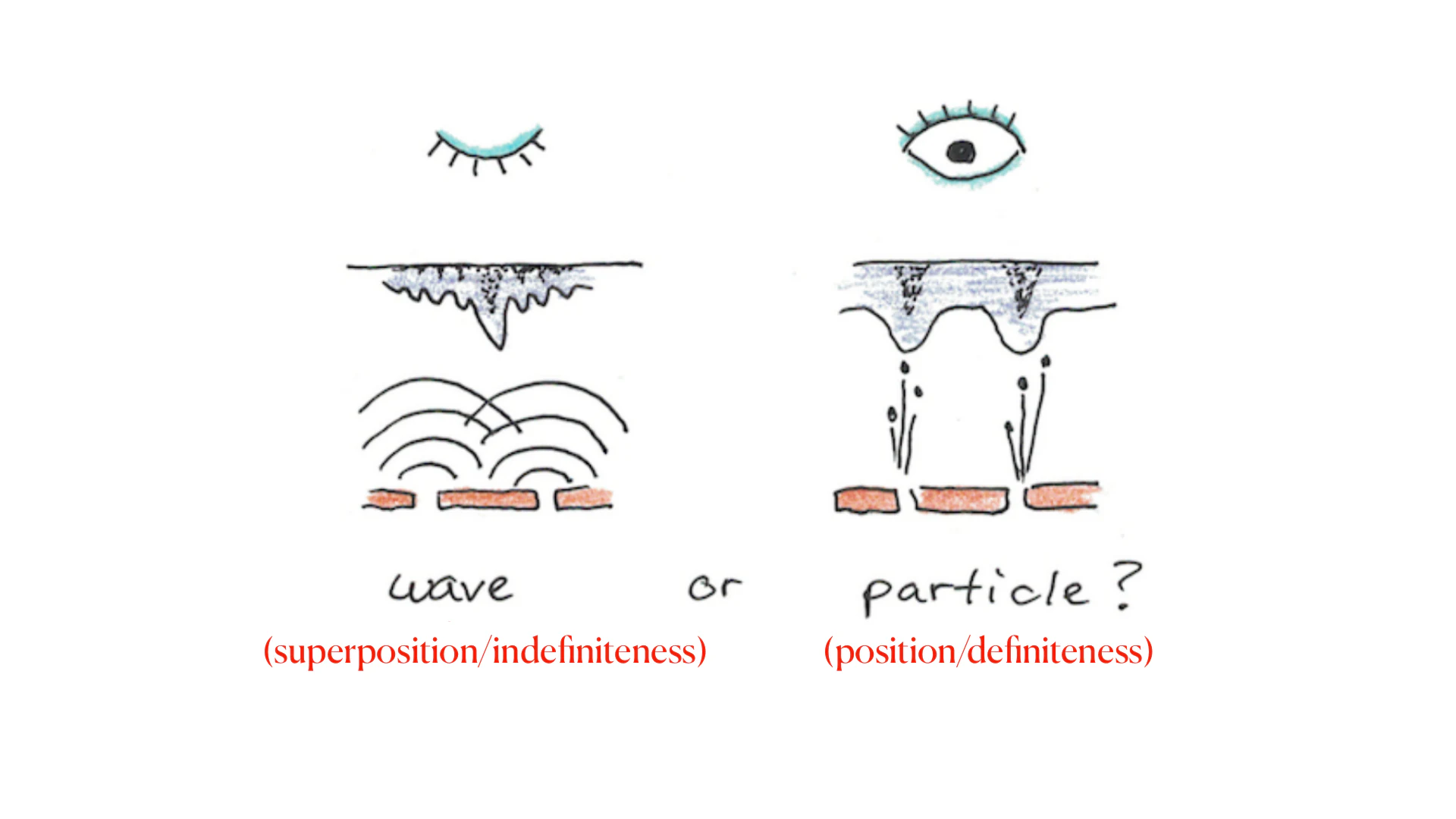 PDF · local
Making sense of quantum mechanics? At least, we try…
This lecture begins with entanglement: a composite quantum state whose parts cannot be described independently. Treating the measuring apparatus and surrounding environment as quantum systems leads to decoherence and helps explain why interference disappears at macroscopic scales, while leaving the problem of definite outcomes open. Copenhagen, dynamical-collapse, hidden-variable, and many-worlds interpretations offer different accounts of the wavefunction and measurement. Bell’s inequalities and the EPR argument then sharpen the stakes, linking quantum correlations to locality, completeness, and the structure of physical explanation.
Open lecture slides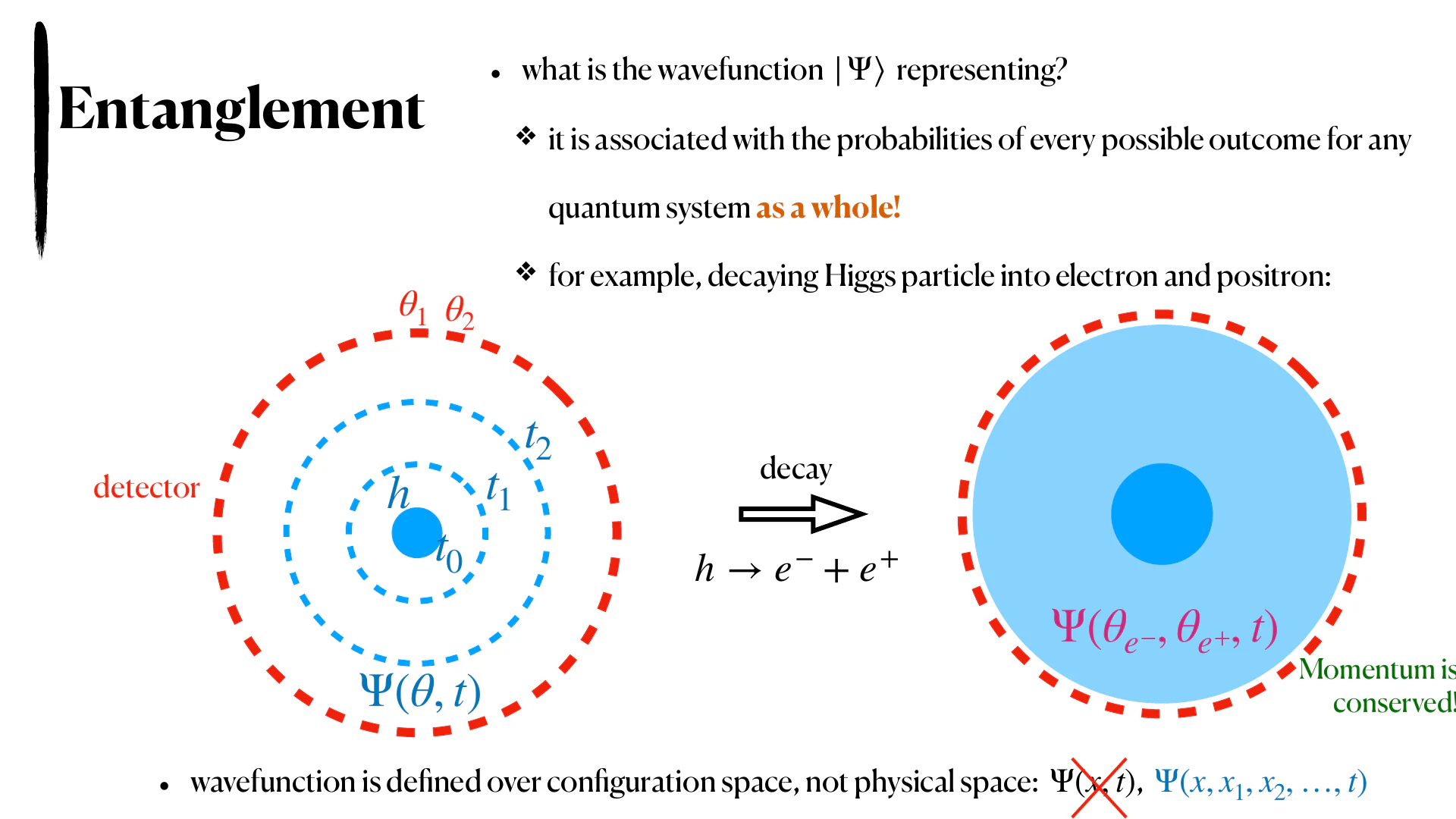 PDF · local
The Physics of Emergence, and the quantum and classical multiverses
The final lecture asks what emergence can mean in physics and what it commits us to ontologically. Dual descriptions, center-of-mass motion, and temperature show how new variables and reliable laws can arise when a system is described at a different level. The classical world is then reconsidered as something that must emerge from quantum mechanics, raising questions about locality, observables, and what it means for an entity to exist in spacetime or in Hilbert space. The course closes with spacetime emergence in quantum gravity and the possibility that even the stage on which physics occurs is not fundamental.
Open lecture slides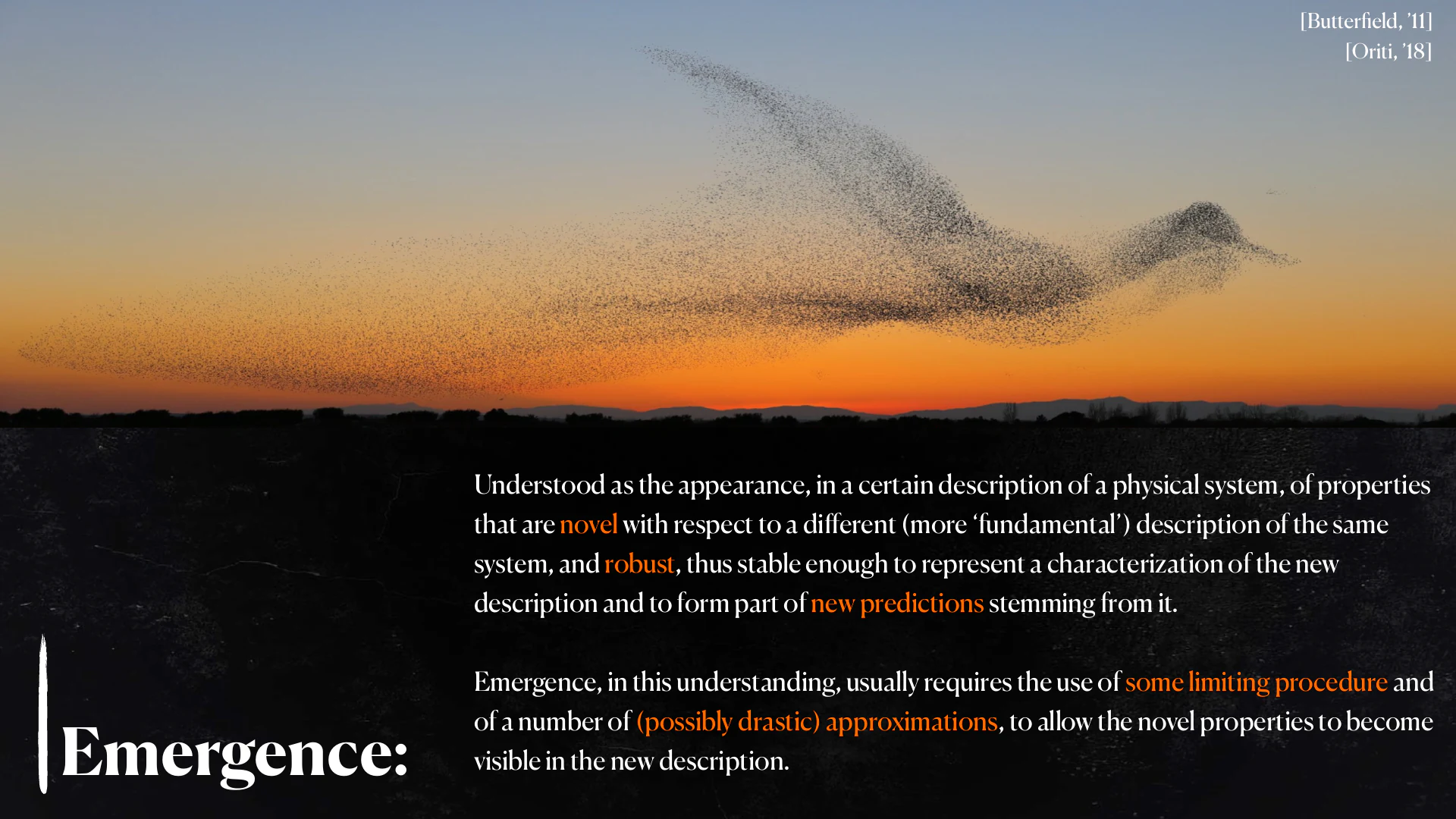 PDF · local