ScientiFikART:When Science meets Art
Proviant, Campus Albano.
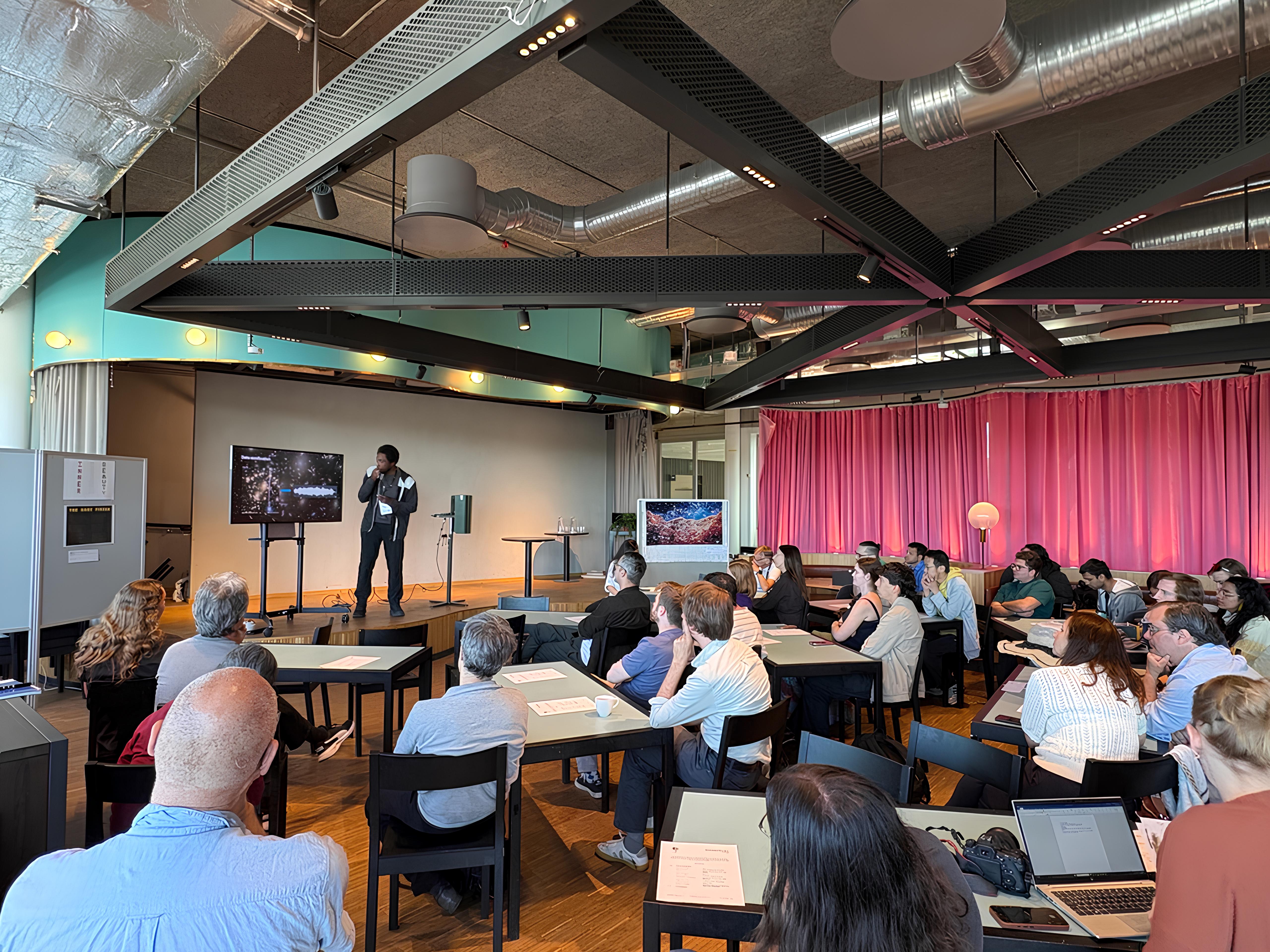
On Friday, 29 May 2026, ScientiFika did something a little different. The screen, the rows of chairs, and the promise of conversation were familiar. What appeared on that screen was not. Over the course of the event, gravitational lensing was explored through sound, an astronomical image was taking shape in cross-stitch, and a scientific paper turned into a black box that asked the viewer to look inside.
This was ScientiFikART: eight short presentations followed by a reception at Stockholm University. Researchers, students, and friends of science had been invited to go beyond the usual explanation of what they study and share something artistic but connected to science.
Where the idea came from
ScientiFikART did not begin with a grand theory about the relationship between science and art. It began by paying attention to the people already coming to ScientiFika.
Over time, we noticed that many attendees had artistic hobbies that were mostly invisible in an ordinary science event, sometimes connected to their research and sometimes simply part of the rest of their lives. Then one attendee approached us with the idea of an evening devoted to science-related poetry. We liked the proposal, but wondered why the invitation should stop at poetry. Why not make room for any artistic medium?
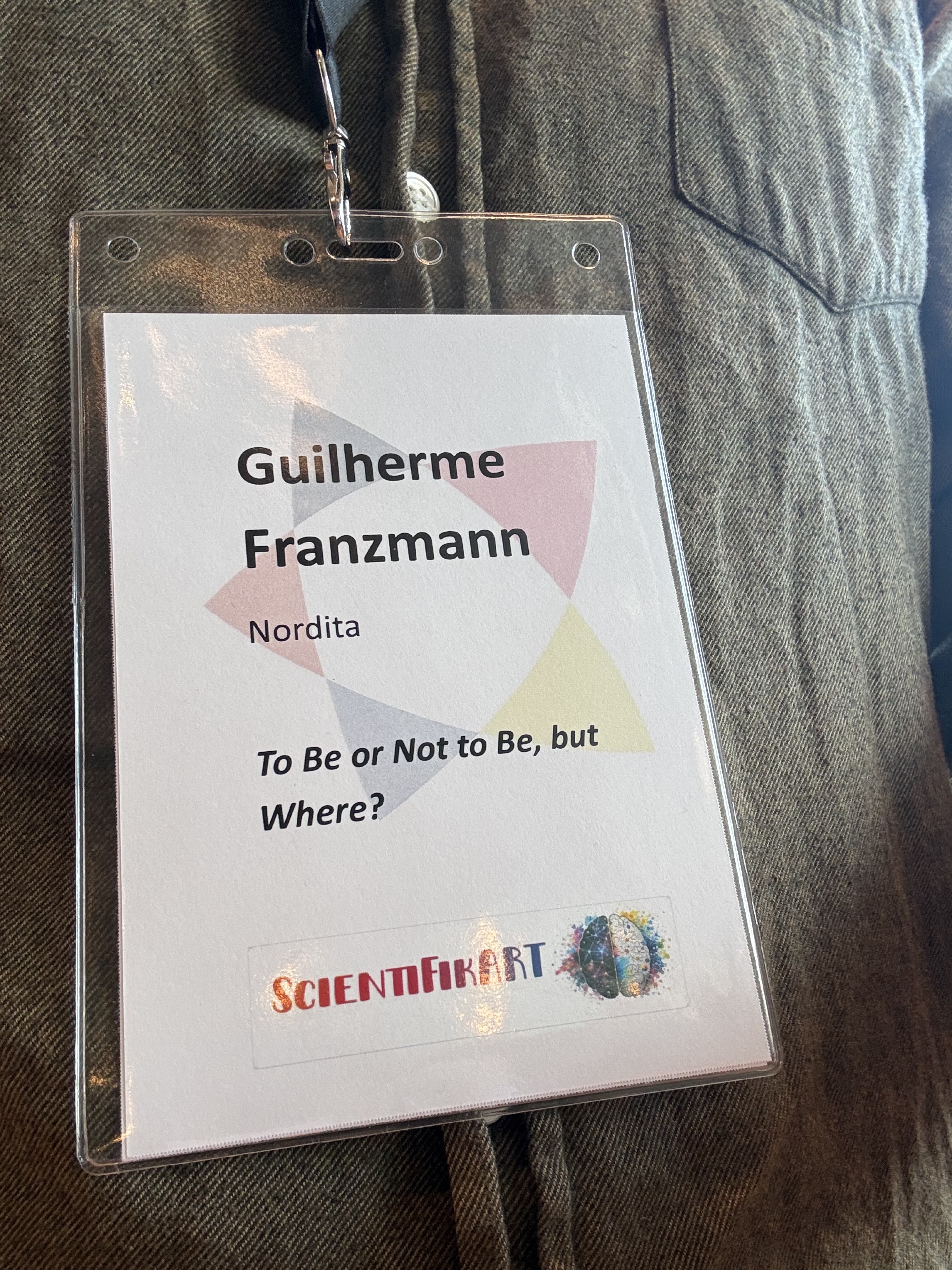
The timing was strangely apt. At almost the same moment, I had been invited to take part in CreSci's experimental Between Art and Science project in Italy, where scientists and artists were asked to cross familiar roles. I have written elsewhere about turning my paper “To Be or Not to Be, but Where?” into a black box and a mirror. That experience made the value of crossing the boundary feel very concrete, and made a ScientiFika art edition seem less like a detour than a natural next experiment.
The programme resisted any simple definition of “science-inspired art.” Benjamin Bose presented The Language of Time. Amna Irshad asked When Antennas Start to Move. Leon Holmgren brought us Saturn. Harriet Wulff presented Cosmic Cross Stitch. I returned to To Be or Not to Be, but Where? Wan-Ting Hseu shared A Day of Ms. Missing. Ludéric Chapel turned to the galaxy cluster Abell 370, using data sonification and spectral rotations to explore how gravitational lensing might become music. Anthony Bonfils closed the presentations with Eurêka Moments: Beauty and the Daemon.
The spark and the fuel
Science is often described as logical, methodical, and disciplined, while creativity is assigned to art. Anyone who has actually tried to do research knows that this division does not survive contact with the work. Choosing a question, finding the right representation, noticing an unexpected analogy, or imagining a way around a dead end all require creativity. Sometimes the decisive idea really does arrive as a spark.
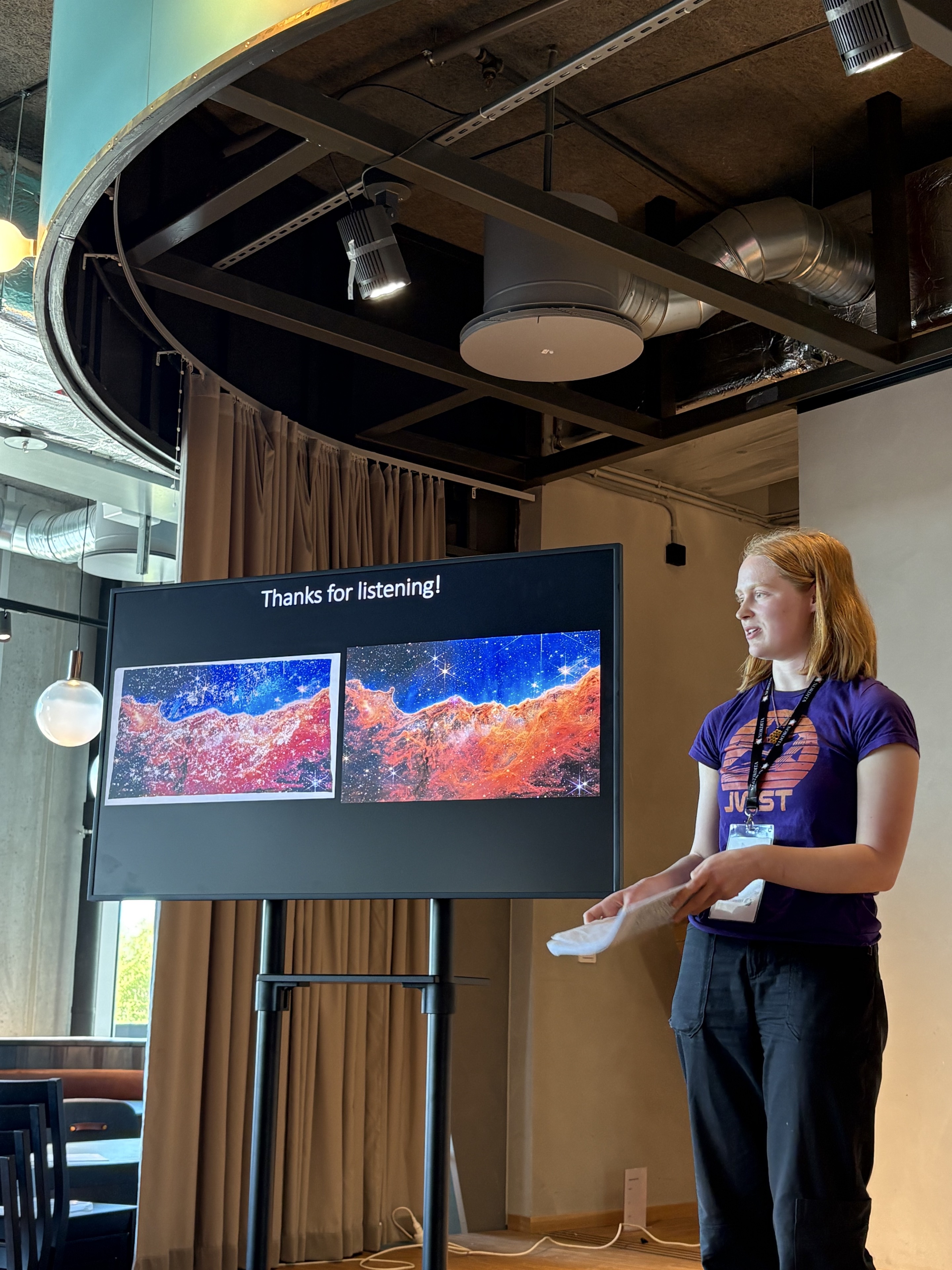
But a spark is not yet a flame. Creativity produces something only when it is joined by persistence: the repeated attempt, the revision, the failed version, the willingness to return. Harriet's Cosmic Cross Stitch made this almost literal. The 550-by-310 pattern contains 170,500 cross-stitch points. Wulff counts four individual stitches per cross, giving 682,000 individual stitches in 84 colours. On the event date, it had been in progress for 2 years, 11 months, and 11 days. The slides jokingly called its scale “artistic hubris,” but it was also familiar to anyone who has lived with a difficult research problem for a long time. The original idea may be exciting; most of the making happens after the excitement has become work.
The evening also made the differences harder to ignore. Art can be judged harshly, of course, and artists work under many constraints. Yet a work rejected by almost everyone may still find a small public for whom it matters. Science answers to another tribunal as well. Nature is ruthless. A scientific idea can be inventive, elegant, and beautiful, but we still want it to be correct, or at least empirically adequate.
That does not make science uncreative, and it does not make art arbitrary. It means that the two practices carry different kinds of responsibility. Perhaps it is also why mathematics and philosophy can sometimes feel closer to the arts: their relation to empirical judgment is less direct, even when rigor remains non-negotiable. The border is real, but it is more interesting when we approach it closely than when we pretend it does not exist.
What stayed with me
What impressed me most that evening was the vulnerability of the people presenting. It is one thing to show colleagues a result in the professional language that everyone expects. It is another to reveal the work one makes outside that language, especially when it is unfinished, personal, playful, or difficult to classify. The quality of the contributions was outstanding, but so was the trust involved in sharing them.
Several people told me afterward that they were happy ScientiFikART had created a social and intellectual space that pulled us away from our usual ways of thinking. I felt the same. The event did not prove that science and art are secretly identical. It did something more useful: it let us move between them long enough to notice what each practice makes possible, what each demands, and what our own community contains when people are given permission to bring more of themselves into the room.
Discussion
Comments
Comments are moderated before appearing. Your email is used only for moderation or a reply and is never published.
Checking for recent comments…
No comments yet.